Frase Review (2026): Features, Pricing, & GEO Performance
Want to rank on Google and stay visible in AI search answers? This Frase review (2026) breaks down how Frase handles SERP research, content briefs, optimization scores, Auto Optimize, and AI visibility tracking plus...

If you’re searching for a Frase review, you’re not looking for “another AI writer.” You’re trying to answer one real question: can Frase help you rank on Google and also get cited inside AI search answers?
Because in 2026, writing is the easy part. Visibility is the hard part. The real challenge is publishing content that doesn’t just show up today, but stays discoverable while AI tools summarize the web and decide which sources get referenced.
That’s why Frase matters more now than it did a couple of years ago. Frase has evolved beyond a simple writing assistant into a workflow that combines SERP research, on-page optimization, and GEO-focused improvements so your content is built to perform in both Google results and AI-generated summaries.
In this guide, I’ll break down Frase like a real user: what it does well, where it falls short, which plan is worth it, and what to use instead if it’s not the right fit.
What is Frase?
Frase is a content intelligence and optimization platform designed to help you go from:
keyword → competitor research → outline → optimized draft → performance improvements
In plain words: instead of guessing what to write, Frase studies what’s already ranking, helps you build a better structure, and pushes you to cover the topics Google (and readers) expect.

What’s new in 2025–2026 is that Frase is also building for “AI search,” not just Google search. They introduced features like AI Visibility (to track your presence in ChatGPT/Gemini/Perplexity/Claude) and a more “agent-like” workflow that tries to guide what to do next.
What can Frase help you create?
Frase can support most content formats that matter in SEO:
- Frase blog posts (long-form and listicles)
- Frase landing pages (service pages, product pages)
- Frase content briefs and outlines (great for teams)
- Frase FAQ sections (powerful for long-tail and snippet opportunities)
- Frase refresh updates for older posts (content decay fixes)
- Frase cluster content planning (supporting articles around a topic)
If your workflow is “research → outline → write → optimize,” Frase is built to compress that cycle.
Key features of Frase
When you open Frase, you’ll notice it’s not just a “writer.” It’s divided into three parts that match how real SEO work happens:
-
Create → where you plan and create content
-
Site → where you audit your website and find issues
-
Analyze → where you track performance, competitors, and AI visibility
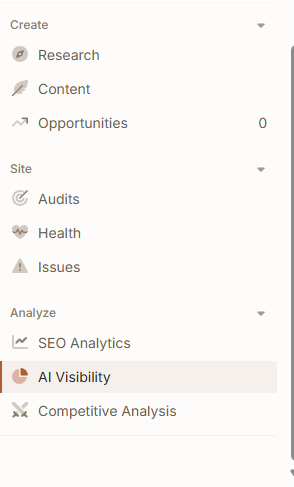
That structure is exactly why Frase feels more like a content SEO system than a typical AI tool.
1) Create: Research Hub (Topic Research, Competitor Analysis, Gap Analysis, SERP Analysis)
This is the screen where Frase starts saving you time.
Most people write content like this:
idea → start writing → publish → pray
Frase flips it:
keyword → what’s ranking → what’s missing → then write
Inside the Research Hub, you can choose different research types:
Topic Research
Use this when you want to deeply understand a topic before writing.
It helps you see:
-
what angles people are covering
-
what questions users ask
-
what subtopics keep repeating across top pages
Example:
You want to write “Best AI tools for students.”
Topic Research will quickly show common sections like:
-
best AI note-taking tools
-
AI tools for assignments and writing
-
plagiarism and originality checks
-
study planning tools
So your article becomes complete before you write a single paragraph.
Competitor Analysis
Use this when you already know the competitors you want to beat.
Frase helps you understand:
-
how competitors structure their content
-
what they cover that you don’t
-
what makes their pages rank
Example:
You’re writing a Frase review and your competitors have:
-
use cases section
-
pricing table
-
pros/cons section
-
FAQs
If you miss any of these, your page looks incomplete compared to SERP leaders. Competitor Analysis makes those gaps obvious.
Gap Analysis
This is for “what I’m missing” compared to the competition.
This feature is powerful because SEO ranking is often not about writing better English—it’s about covering the missing sections that Google expects.
Example:
If top pages talk about “GEO + AI visibility tracking” and you don’t, your review feels outdated. Gap Analysis pushes you to add what matters now.
SERP Analysis
This is the most practical one for SEO writers.
It helps you understand:
-
what type of content is ranking (review, guide, listicle)
-
what intent Google is rewarding
-
how deep competitor pages are going
Example:
If SERP analysis shows top results are all “Frase review + pricing + alternatives”, then writing a simple “What is Frase” article won’t rank. You need commercial intent structure.
Why this feature matters:
It forces you to stop guessing and start writing based on evidence.
2) Create: Content (Optimize Existing Content / Import Draft Content)
This screen is where Frase becomes genuinely useful for people who already have content.
Because here’s the truth:
Most blogs don’t grow by posting new articles only.
They grow by improving pages that already have impressions and are “almost winning.”
In the Content section, Frase lets you:
-
paste a draft
-
import from a URL
-
import from Notion/Google Docs
…and then it analyzes your content for optimization.
What Frase is doing here?
It’s comparing your page against the top pages and asking:
-
Are you missing important subtopics?
-
Is your structure weak?
-
Are you covering the intent properly?
Example (from your screenshot):
You paste your blog “What is Generative AI?”
Frase may suggest improving:
-
intro clarity
-
missing sections
-
better headings
-
FAQs
-
supporting examples
So your article becomes “complete” in the way Google prefers.
Best use case:
When you have a draft and want a fast quality upgrade.
3) Create: Opportunities (Quick Wins / Growth / Strategic)
This is the screen that most bloggers ignore, but it’s one of the most valuable.
Because Opportunities answers the question:
“What should I work on next for maximum SEO impact?”
You’ll see tabs like:
-
Quick Wins
-
Growth
-
Strategic
Quick Wins (the money screen)
Quick Wins usually mean:
“You’re already close. Small changes can push you higher.”
Example:
Your post is ranking at #11 or #12.
That’s page 2 → zero traffic zone.
Frase will nudge you toward:
-
adding missing competitor topics
-
improving headings
-
strengthening FAQs
-
fixing intent mismatch
This is exactly how you move from:
page 2 → page 1
Growth
These are opportunities that need more work but can bring real traffic.
Example:
A category page or cluster topic you haven’t built yet.
Strategic
These are long-term plays:
-
big clusters
-
high-competition topics
-
content that needs deeper authority
Why this feature matters:
It saves you from random publishing and gives you a roadmap.
4) Analyze: AI Visibility (Track Your AI Visibility)
This is Frase’s modern feature and it matches your “GEO performance” angle perfectly.
AI visibility means:
Do AI tools mention your brand when users ask questions?
In the AI Visibility screen, you can:
-
add prompts people may ask
-
track whether your site appears in AI search responses
Real prompts you can track (use these in your blog)
-
“Best AI tools for content writing”
-
“Best AI tools for SEO”
-
“Best alternatives to Frase”
-
“Best AI tools directory”
-
“Best AI tools website”
This is useful because AI search is becoming a real discovery channel.
Even if it doesn’t send huge traffic today, it builds brand visibility and authority.
Why this feature matters:
It makes AI search measurable. You’re not guessing anymore.
5) Analyze: Competitive Analysis (compare your pages with competitors)
This is your direct “beat competitor” screen.
You enter your page URL and competitor pages, and Frase compares:
-
structure differences
-
topic coverage gaps
-
optimization opportunities
Example:
You compare your “Frase review” page with 3 competitors.
If they include:
-
pricing table
-
comparison section
-
FAQs
-
“who it’s for” section
…and you don’t, Frase will push you to add them.
Why this matters:
Because ranking is often about being the most complete answer in the SERP.
6) Site: Audits (Forensic Auditor)
This is where Frase behaves like a content SEO auditor.
If you run a site audit, it helps you find:
-
content decay (pages losing performance)
-
pages needing refresh
-
optimization opportunities across the site
Example:
Your “AI tools for students” post did well last year but now traffic is dropping.
A forensic audit helps you spot:
-
outdated sections
-
missing 2026 updates
-
competitor gaps
Why this matters:
SEO is not “write once.” It’s “refresh and maintain.”
Frase for SEO + GEO (what changed in 2025–2026)
Older reviews of Frase mostly covered:
- research
- outline
- content scoring
- AI writer
The newer Frase positioning is very clear:
“Rank on Google. Get cited by AI.”
That shift matters because content discovery is splitting into two channels:
- classic Google rankings
- AI answers that summarize the web
It is building workflows that try to serve both:
- optimize for traditional SEO completeness
- structure content in ways that work well for AI citation patterns (clear headings, FAQs, definitions, entities, structured explanation)
If your content strategy is purely “write and pray,” this is exactly the kind of system that can force you into a cleaner method.
Pros of using Frase
- Fast research and outlining (huge time saver)
- Strong for content refresh workflows (often faster ROI than writing new posts)
- SEO + GEO optimization positioning is aligned with where search is going
- Auto Optimize helps scale improvements across a portfolio
- Content Opportunities helps prioritize updates using GSC signals
- AI Visibility tracking is a rare feature for teams experimenting with AI discovery
- 7-day free trial, no credit card lowers risk for testing
Cons of using Frase
Let’s keep this real.
- Not a full replacement for deep SEO suites (backlinks, technical audits, huge keyword databases)
- AI writing still needs strong editing (generic output risk)
- If you only want a basic AI writer, you may feel Frase is “too much”
- If your strategy is mostly link building + technical SEO, you’ll use Frase as a supporting tool, not the core
This isn’t a weakness it’s just clarity on what Frase is built for: content performance workflows.
Who should use Frase?
Best for
- bloggers who publish regularly and want SERP-driven structure
- content teams writing at scale (brief → writer → editor)
- agencies managing multiple client blogs
- SaaS marketing teams building topical authority
- brands exploring AI search visibility and wanting measurement
Not ideal for
- teams that don’t publish content (content isn’t your growth lever)
- people who only want “generate content fast” without optimization
- those needing heavy technical SEO crawling and backlink intelligence as the primary toolset
Frase pricing & plans (updated for 2026)
Frase’s official pricing states:
- Plans from $39/month
- 7-day free trial
- No credit card required
- Every plan includes the “complete Frase Agent” including research, optimization, AI visibility tracking, site audits, publishing, and API

Their features page also lists plan tiers and what they include (example: Starter/Professional/Scale/Enterprise) with differences in seats, article volumes, and AI platforms tracked.
Quick plan guidance
- Starter plan: best if you’re solo and publishing limited content
- Professional plan: best for small teams/agency workflows
- Scale plan: best for high-volume content and bigger operations
- Enterprise plan: best for custom needs (SSO, higher governance, etc.)
If you’re unsure, test the trial and run one real workflow:
- pick one keyword
- build an outline
- draft 1,500–2,000 words
- run Optimize
- compare your final output vs top SERP pages
That will tell you more than any review.
My verdict
Frase is worth it when content is your main growth engine and you care about:
- research speed
- structure quality
- content refresh improvements
- on-page optimization with clearer execution steps
- early experiments in AI visibility tracking
But Frase is not meant to replace everything. If your SEO stack needs deep backlinks, massive keyword research data, and technical diagnostics, you’ll still pair Frase with a full SEO suite.
So think of Frase as:
a content intelligence layer + optimization engine, not your entire SEO universe.
Best Frase alternatives (by scenario)
Alternatives for full SEO data (keyword + backlinks + technical)
If you want deep keyword difficulty, link intelligence, and technical audits, full SEO suites are still unmatched. These tools are powerful but often lack the “content workflow” layer Frase is trying to build.
Best for: SEO managers, link builders, enterprise SEO teams
Not best for: creators who need writing/briefing systems built-in
Alternatives for on-page optimization
If your primary need is “content scoring + SERP-based terms,” on-page optimizers compete directly with Frase.
Frase even publishes direct comparisons (example: Frase vs Surfer SEO) that show how they position value and features.
Best for: content writers + SEOs focused on on-page
Not best for: teams needing a bigger “agent + workflow + AI visibility” layer
Alternatives for pure AI writing
If you only want fast drafting for blogs, social media, and general copy pure AI writing tools can be cheaper and simpler.
Best for: drafting speed
Not best for: SERP-based outlining and content optimization workflows
Frase: FAQs
Is Frase good for SEO in 2026?
Yes, Frase’s strongest value is still SERP-driven research + content optimization workflows. The new layer is GEO/AI visibility tracking.
Does Frase help with AI search visibility?
Frase launched AI Visibility tracking across ChatGPT, Gemini, Perplexity, and Claude, so you can measure where your brand shows up and improves over time.
Is there a free trial?
Yes, Frase pricing pages mention a 7-day free trial with no credit card required.
Does Frase replace a full SEO suite?
Usually no. Frase is best as a content workflow and optimization system. For deep backlink research, technical crawling, and very advanced keyword databases, teams still use separate SEO suites.
Where this fits in your AI tools stack?
Most people don’t need “more tools.” They need a repeatable system.
If your system is:
- publish consistently
- update older posts
- build topical coverage
- and now also test AI discovery channels
…then Frase can fit nicely.
And if you’re building your own stack of AI Tools, it helps to compare tools based on workflow, not hype.
That’s exactly what we do on Simplify AI Tools we review tools by real scenarios: who it’s for, what it replaces, and what it doesn’t.

Disclaimer: Views are the author’s own. Content is informational only.
Was this article helpful?
A quick vote helps us improve the guides readers find most useful.
Join the discussion
Share your experience, ask a question, or add something useful for other readers.