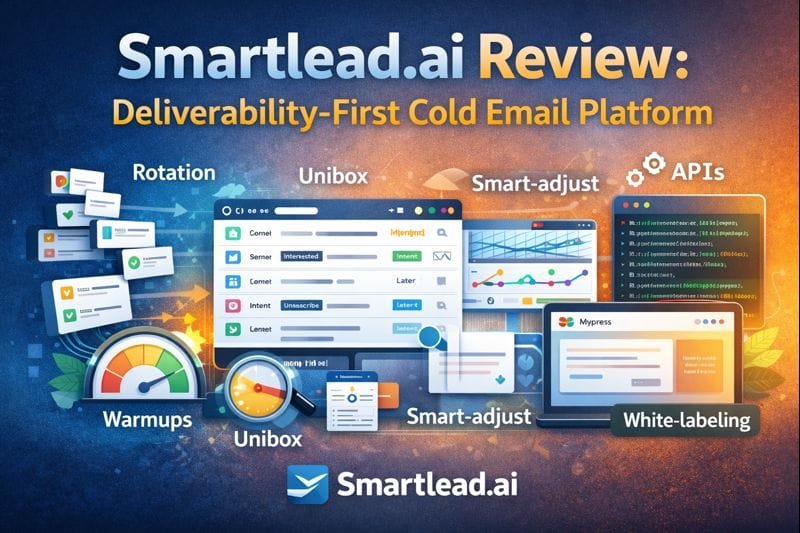
Smartlead ai is more than just a cold email sender; it is an outbound infrastructure that focuses on making money. That difference is important because most cold email tools are designed to send sequences and track replies. Smartlead, on the other hand, is designed to protect deliverability at scale, centralize inbox and intent signals, support agencies and multi-client setups, and serve as the backbone for outbound revenue workflows. You can see this in almost every claim on their site, such as “unlimited mailboxes,” “unlimited warmups,” “inbox placement,” “rotation,” “the unibox,” “automation,” “APIs,” and “white-labeling.”
- “unlimited mailboxes,”
- “unlimited warmups,”
- “inbox placement,”
- “rotation,”
- “the unibox,”
- “automation,”
- “APIs,”
- “white-labeling.”
Smartlead is made for people who send a lot of cold emails and don’t want them to end up in spam. If outbound is a big part of your pipeline, the promise isn’t “send more emails,” it’s “send consistently without burning domains and losing visibility.” You can start with Smartlead on Simplify AI Tools if you want a quick look inside our directory before going deeper.
Smartlead’s main promise is to turn cold emails into steady income.
This headline is important because it tells you what Smartlead is really selling. They are not marketing themselves as a simple tool for automating follow-ups. They are selling dependability and predictability, which is what most teams lose as soon as they try to grow cold outreach.
Domain burnout, a bad sender reputation, having to manage your inbox by hand, having tools that don’t work together, and spam placement without warning are the main reasons why cold email doesn’t work at scale. Smartlead’s main point is that if you use their infrastructure-first system, your outreach will be stable, scalable, and repeatable. That one idea is the basis for everything on their platform narrative.
To get a better idea of Smartlead’s position, you should look at Smartlead.ai directly. The language they use always focuses on infrastructure and deliverability instead of just “automation.”
Why adoption signals are important for cold outreach tools
A lot of people leave cold outreach platforms. People try things out for a few weeks, their performance drops, and then they switch to a different tool in the hopes of a quick fix. That’s why a lot of people using it can be important in this area. It often means that the product is being used in long-term outbound SOPs, especially by agencies and small and medium-sized business (SMB) teams that want things to go smoothly and be done the same way every time.
Smartlead’s features are perfect for that audience: a multi-mailbox strategy, centralized operations, and deep automation based on stability.
The main feature is auto-rotating email accounts.
This is the most important technical difference that sets Smartlead apart from the rest.
Email services like Google and Outlook have daily sending limits, spam heuristics, and signals that show how trustworthy a sender is. Sending a lot of mail from one inbox is dangerous. Sending smaller amounts of mail to many inboxes every day is a safer model. Smartlead is meant to make that model work automatically.
Smartlead pools connected mailboxes, rotates senders automatically, balances sending load, and helps keep daily limits safer. This way, you don’t have to make separate campaigns for each mailbox and keep track of sending limits by hand. Serious outbound teams want higher inbox placement, longer domain lifespan, and predictable scaling as their practical outcome.
This is more about infrastructure than about campaigns. You stop asking yourself, “How do I send more emails?” and start asking yourself, “How do I grow without hurting my reputation?”
Unlimited warmups with conversations that sound real
People often think of warmup as a one-time step in the onboarding process. Reputation is something that happens all the time. Many warmup tools use patterns that repeat themselves, which can look strange.
Smartlead focuses on warmup as behavior simulation, which includes natural conversations, replies that sound like they’re coming from a real person, inbox movements, and spam folder rescue behavior. The main point is that warmup isn’t about volume; it’s about realistic engagement behavior. Reputation signals stay healthier over time when inboxes are kept busy with opens, replies, threaded conversations, and corrections from inbox to spam. This is why Smartlead doesn’t want anything limited or “setup-only” for warmup; they want it to be unlimited and ongoing.
Smart-adjust: protect deliverability before damage spreads
Most tools for sending cold emails will show you the problem after it has already happened. You notice that the reply rate is going down and the opens are moving, and then you realize that the inbox placement is also starting to slide.
Smartlead’s Smart-adjust style layer is meant to stop problems before they happen. It keeps an eye on drops in engagement and campaign health signals, and then changes how it sends to protect the sender’s reputation. This is important for people who send a lot of emails because small drops in deliverability can quickly add up when you send emails to a lot of mailboxes and domains.
Unibox: keeping track of replies and intentions in one place
When replies to cold emails are spread out over many inboxes, it becomes a pain to deal with. You lose context, responses take longer, and follow-ups are less helpful.
Smartlead’s unibox method is meant to fix that by putting all replies from all inboxes into one view, keeping the context, and making it easier to act on intent signals. Their own product page for this is Unified Master Inbox by Smartlead. You can see how they explain it there.
For agencies, the value grows because it makes it easier to handle multiple clients, domains, and conversations without making the operation a mess in the inbox.
Categorization of lead intent and subsequences based on AI
Smartlead uses a machine-learning-like method to sort replies into groups based on their intent and separate leads who are interested from those who are not. That gets rid of a lot of manual work, like tagging, cleaning up the CRM, and trying to figure out what to do next.
When combined with subsequences based on behavior, this intent layer becomes even more useful. The flow can change based on signals, so not every prospect has to go through a set linear sequence. Positive replies can lead to a booking, “later” replies can stop and start again, opens without replies can start nudges, and unsubscribes can use global blocklist rules. This is where Smartlead stops being sequence-driven and starts being workflow-driven. It’s also where “consistent revenue” starts to seem more realistic in terms of how it works.
Outbound infrastructure that starts with APIs
Smartlead talks about APIs a lot, which is a strong sign of who the product is made for. APIs aren’t mostly for people who are just starting out. They are for agencies with their own systems, SaaS outbound teams, and people who build automation.
With APIs, teams can automatically create campaigns, sync leads from databases, start sequences programmatically, make custom dashboards, and connect outbound execution to their internal CRM and reporting stack. That means Smartlead can be used as a cold email engine, not just as a UI tool.
SmartDelivery, SmartSenders, and SmartServers make up the infrastructure stack.
These features show that vertical integration is happening. Smartlead is not just a campaign tool; it also has layers that make it easier to set up and deliver. This is an easy way to read them:
| Layer | What it is supposed to fix | Why it is important |
|---|---|---|
| SmartDelivery: | Testing and improving inbox placement | You find problems with deliverability sooner. |
| SmartSenders | Workflows for setting up SmartSenders domains and mailboxes | You make fewer mistakes when setting things up and speed up growth. |
| SmartServers | Dedicated controls for sending infrastructure | You separate performance from reputation and control it. |
Smartlead feels more like infrastructure than a regular cold email tool because of this “stack thinking.” Smartlead isn’t trying to get you to connect multiple vendors and workflows; instead, they’re trying to own more of the outbound stack from start to finish.
White-labeling: a way for agencies to make more money
White-labeling is not just for looks. It makes it possible to have branded client dashboards, cleaner client reporting, client-facing access, and easier management of multiple clients. That changes how the tool fits into the business model for lead generation companies. Instead of being a tool that sits quietly behind the scenes, Smartlead becomes the backend engine that you can package into a service offering.
How to think about pricing in a smart way
Smartlead pricing is best thought of as a “infrastructure ladder,” where the more you use it and the more work you do, the more it costs. You can see how Smartlead pricing is set up right now.
A simple way to understand it:
| Level of planning | Best for: | Why it works |
|---|---|---|
| Plan for entry | Solopreneurs testing outbound | Easy to start with, but still built for growth |
| In the middle of the plan | Adding more teams that work outside | Better control over operations and automation |
| Big plan | Agencies and people who send a lot of mail: | scale, advanced features, and a focus on white-labeling |
The names of the plans don’t matter. The most important thing is the operating model. Smartlead wants you to grow in a planned way, with add-ons and controls that help you reach out to people over the long term.
What Smartlead doesn’t do
Smartlead doesn’t make your ICP, doesn’t guarantee answers, doesn’t replace sales skills, and doesn’t magically fix bad copy. It gives you infrastructure and automation, but not demand. The real performance still depends on the quality of the list, the targeting, the relevance, and the messaging.
If you need help with the writing, you can use internal tools like Generating cold email copy and High-conversion cold email prompts to speed up variations, angles, and follow-up structures.
Who Smartlead is best for and what the final decision is
Smartlead is best for businesses that do a lot of cold emailing, lead generation agencies, recruiters, sales development teams, and SaaS outbound teams that do a lot of outbound work. It’s not good for people who send out newsletters, one-time campaigns, or low-volume messages, or anyone who wants a quick way to “press a button and get replies.”
Smartlead.ai is not a toy for kids. It is a serious outbound infrastructure platform made for agencies, revenue teams, and businesses that need to grow, be reliable, and make money. The real value comes from protecting deliverability, having a rotation strategy, always warming up, using unibox for centralized reply operations, having a lot of automation with intent-driven workflows, and owning the infrastructure through its stack approach.
Smartlead is perfect for you if cold email is a big part of your business. It might be too much if you only do outreach once in a while. Smartlead’s own FAQ is also worth reading for more information on how the platform works in unusual situations and when it’s being used.
