AI Detector: 10 Best Tools to Detect AI Content in 2026
Looking for the best AI detector in 2026? Here are 10 AI content detection tools to check ChatGPT, GPT-4, Gemini, Claude and AI-written text, with pricing, pros, cons and limitations...

Students use ChatGPT to draft assignments. Bloggers use AI to create outlines. Marketers use AI tools for emails, ads and SEO content. Businesses use Claude, Gemini and GPT-based tools to speed up daily work.
But this has created one big problem: how do you know whether a piece of content was written by a human or generated by AI?
That is where an AI detector comes in.
An AI detector helps you analyse text and estimate whether it was written by a human, generated by AI or edited with AI assistance. These tools are useful for teachers, content editors, SEO teams, publishers, recruiters, agencies and business owners who want to check content originality.
At Simplify AI Tools, we believe AI detectors should be used as helpful signals, not final proof. No AI detector is perfect. False positives and false negatives can happen, especially when content is edited, translated, paraphrased or written in a very formal style.
Still, AI content detectors can be useful when you know how to use them properly.
In this guide, we will look at the 10 best AI detector tools in 2026, including free and paid options.
What Is the Best AI Detector in 2026?
The best AI detector in 2026 depends on your use case. Originality.ai is strong for publishers and website owners, GPTZero is popular for education, Copyleaks is useful for enterprise and multilingual detection, Winston AI is good for text, image and document scanning, while Scribbr and QuillBot are useful free options for students and casual users. However, no AI detector should be treated as 100% accurate.
What Is an AI Detector?
An AI detector is a tool that analyses text and estimates whether it was written by a human or generated by artificial intelligence.
Most AI detectors look at writing patterns such as:
- Sentence structure
- Word predictability
- Repetition
- Tone
- Fluency
- Paragraph style
- Consistency
- Probability patterns
For example, AI-written content may sometimes sound too polished, too balanced, too repetitive or too generic. AI detectors try to identify these patterns and give a score such as “likely human”, “possibly AI”, “AI-generated” or a percentage-based result.
AI detectors can usually check content created by tools such as:
- ChatGPT
- GPT-4 / GPT-5
- Claude
- Gemini
- Copilot
- Jasper
- DeepSeek
- Other large language models
Why AI Detectors Matter in 2026
AI detectors matter more in 2026 because AI-generated content is now common in education, SEO, journalism, marketing, business communication and publishing.
For teachers, AI detectors can highlight assignments that may need a closer look. Website owners can use them to spot generic or low-value AI-written content before publishing. SEO teams can include them in their editorial review process to maintain content quality. Agencies can use these tools to build transparency and trust with clients. For publishers, AI detectors can help reduce the risk of publishing repetitive, unverified or low-quality AI-generated content.
But the goal should not be to punish AI usage blindly. The better approach is to check whether the content is useful, original, accurate and genuinely helpful for readers.
Are AI Detectors Really Reliable?
AI detectors are useful, but they are not always reliable. This is very important.
An AI detector can wrongly flag human-written content as AI-written. It can also miss AI-generated content if the text has been heavily edited, rewritten or mixed with human writing.
No AI detector can provide complete accuracy. Even strong tools have limitations, especially across different languages, writing styles, short text samples and heavily edited AI-assisted writing.
So, use AI detectors as a supporting tool, not as the only evidence.
Top 10 Best AI Detector Tools in 2026
Here are the best AI detector tools to try in 2026:
- Originality.ai
- GPTZero
- Copyleaks
- Winston AI
- Grammarly AI Detector
- QuillBot AI Detector
- Scribbr AI Detector
- Smodin AI Detector
- ZeroGPT
- BrandWell AI Detector
Now let’s look at each one in detail.
1. Originality.ai
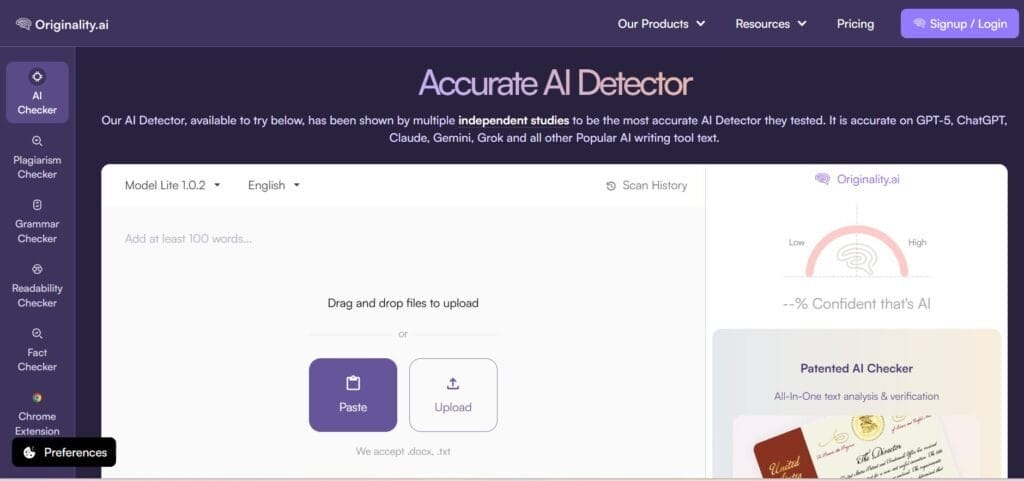
Best for: Publishers, agencies, SEO teams and website owners
Pricing: Paid plans available
Good for: AI detection, plagiarism checking, readability and site-level content checks
Originality.ai is one of the most popular AI detector tools for professional content teams. It is especially useful if you manage blogs, websites, content agencies or editorial workflows.
The tool is not just an AI detector. It also includes plagiarism checking, readability checking and fact-checking support depending on the plan. This makes it useful for teams that want a complete content quality workflow.
Its pricing may change over time, so always check the official pricing page before subscribing.
Key Features
- AI content detection
- Plagiarism checker
- Readability analysis
- Fact-checking support
- Website content scanning
- Team-friendly workflow
Pros
- Strong option for publishers and SEO teams
- Useful for checking full website content
- Combines AI detection with plagiarism checks
- Suitable for agencies and content managers
Cons
- Not the best free option
- Results should still be manually reviewed
- May be more than casual users need
Best Use Case
Use Originality.ai if you publish a lot of content and want to check AI probability, plagiarism and readability before publishing.
2. GPTZero

Best for: Teachers, students, universities and writing review
Pricing: Free and paid plans available
Good for: Educational AI detection and writing analysis
GPTZero is one of the most recognised AI detector tools, especially in education. It is commonly used by teachers and academic users to check whether essays, assignments or written answers may contain AI-generated text.
GPTZero can be useful for checking content from ChatGPT, Claude, Gemini and other AI tools. It also offers writing-level insights depending on the plan.
Key Features
- AI text detection
- Writing analysis
- Sentence-level highlighting
- Google Docs support
- Educational use cases
- Free plan available
Pros
- Popular in schools and colleges
- Easy to use
- Good for assignment checks
- Useful writing feedback features
Cons
- May flag polished human writing
- Free plan has limits
- Should not be used as final proof against students
Best Use Case
Use GPTZero if you are a teacher, student or academic reviewer who needs a quick AI content check with writing-level insights.
3. Copyleaks
Best for: Enterprise teams, education platforms and multilingual detection
Pricing: Free access and paid plans available
Good for: AI detection, plagiarism detection and API use
Copyleaks is a strong AI content detection platform for businesses, academic institutions and content-heavy teams. It supports AI detection for ChatGPT, Gemini, Claude and other models.
It is especially useful when you need AI detection at scale, multilingual support or API access for a larger workflow.
Key Features
- AI content detection
- Plagiarism checking
- Multilingual support
- API access
- LMS and enterprise use cases
- AI image scanning on some plans
Pros
- Good for large organisations
- Useful for education and enterprise
- Supports multiple languages
- API options available
Cons
- Pricing can be more suitable for teams than individuals
- Accuracy claims should be treated carefully
- Setup may feel advanced for casual users
Best Use Case
Use Copyleaks if you need AI detection at scale, especially for education platforms, businesses or multilingual content workflows.
4. Winston AI
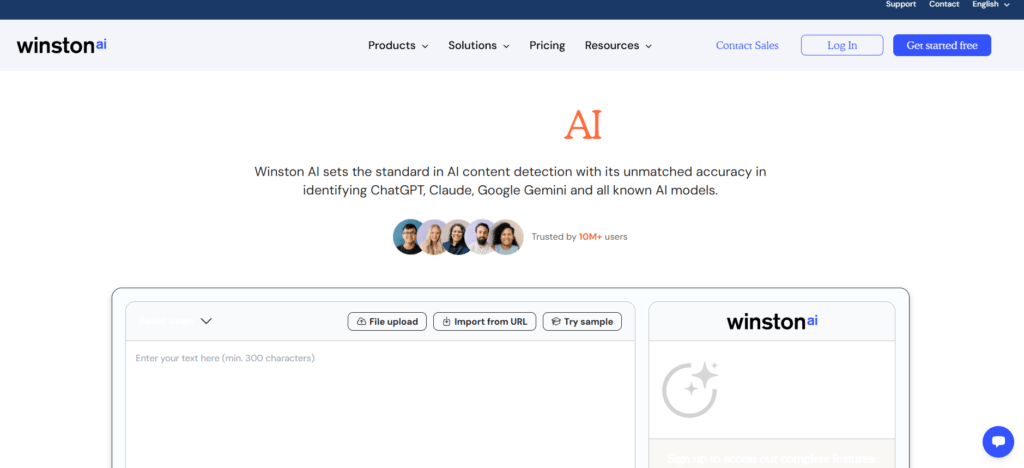
Best for: Publishers, teachers and document-based AI detection
Pricing: Free trial and paid plans available
Good for: AI text detection, plagiarism, OCR and AI image detection
Winston AI is another popular AI detector. It is designed for teachers, publishers and professional content teams.
It is useful when you want a professional AI detector with document scanning, plagiarism checking and reporting options.
Key Features
- AI content detection
- Plagiarism checker
- AI image detection
- OCR document scanning
- PDF reports
- Team access on higher plans
Pros
- Useful for text and document scanning
- Good interface for reports
- Includes plagiarism and image detection features
- Helpful for educators and publishers
Cons
- Advanced features require paid plans
- Credit-based usage needs monitoring
- Not every user needs image detection
Best Use Case
Use Winston AI if you want a professional AI detector with document scanning, plagiarism checking and report generation.
5. Grammarly AI Detector
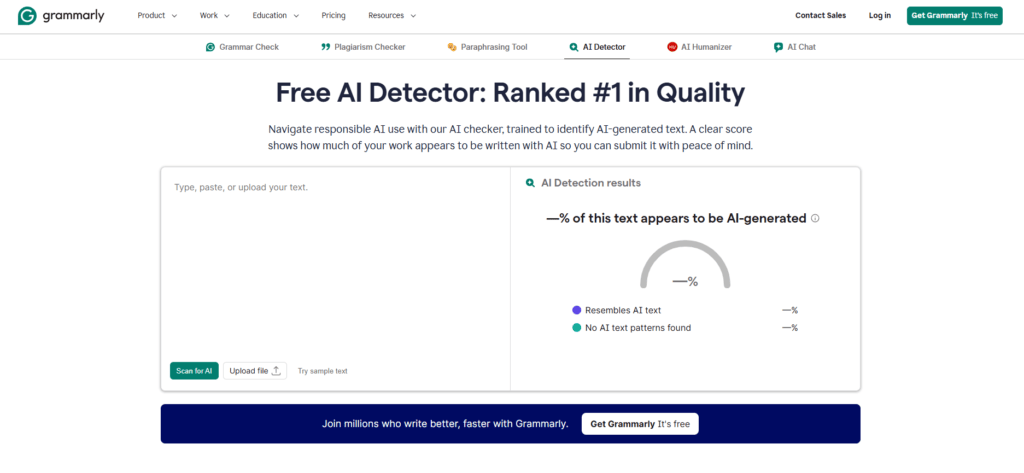
Best for: Writers, students and professionals already using Grammarly
Pricing: Free AI detector available with paid Grammarly plans for advanced writing support
Good for: Writing improvement and basic AI content checking
Grammarly is best known as a grammar and writing assistant, but it also offers AI-related writing support and detection features.
The biggest benefit is convenience. Many users already use Grammarly for grammar, spelling, tone and clarity, so its AI detection feature can fit naturally into an existing writing workflow.
Key Features
- Grammar checking
- Tone improvement
- Writing suggestions
- AI writing assistance
- AI detection support
- Browser and app integrations
Pros
- Easy for everyday users
- Good writing improvement tools
- Useful for students and professionals
- Works across many platforms
Cons
- AI detection is not its only focus
- Not ideal for deep editorial audits
- Paid plan may be needed for full writing features
Best Use Case
Use Grammarly if you want writing improvement and basic AI detection in one familiar tool.
6. QuillBot AI Detector
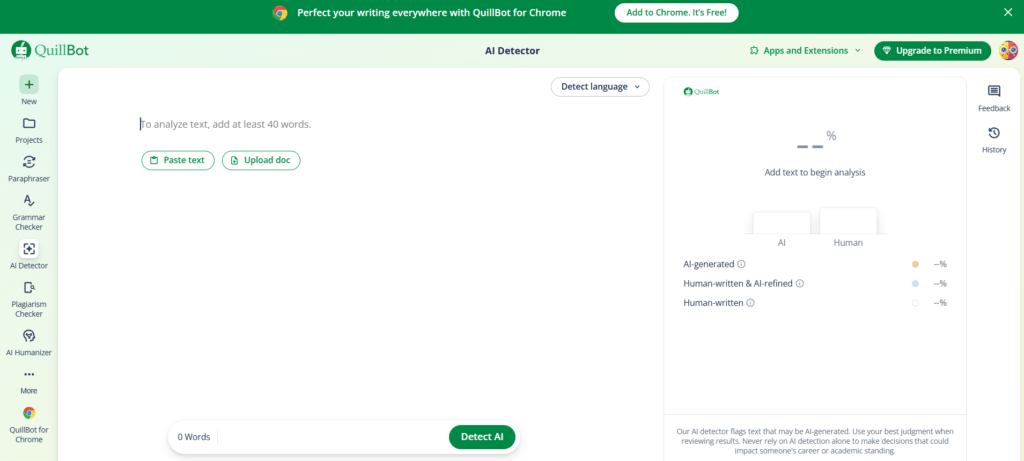
Best for: Students, writers and casual AI checking
Pricing: Free AI detector available
Good for: Quick AI detection and writing support
QuillBot is widely known for paraphrasing, grammar checking and summarising, but it also offers a free AI detector.
This makes it a simple option for students, bloggers and professionals who want quick AI detection without setting up a complex tool.
Key Features
- Free AI detector
- Paraphrasing tool
- Grammar checker
- Summariser
- Translator
- Citation tools
Pros
- Free and easy to access
- Good for quick checks
- Useful writing toolkit
- Beginner-friendly
Cons
- Not as advanced as enterprise tools
- Accuracy may vary by text type
- Paraphrased AI content can be harder to detect
Best Use Case
Use QuillBot AI Detector if you want a quick, free and simple AI checker for everyday writing.
7. Scribbr AI Detector
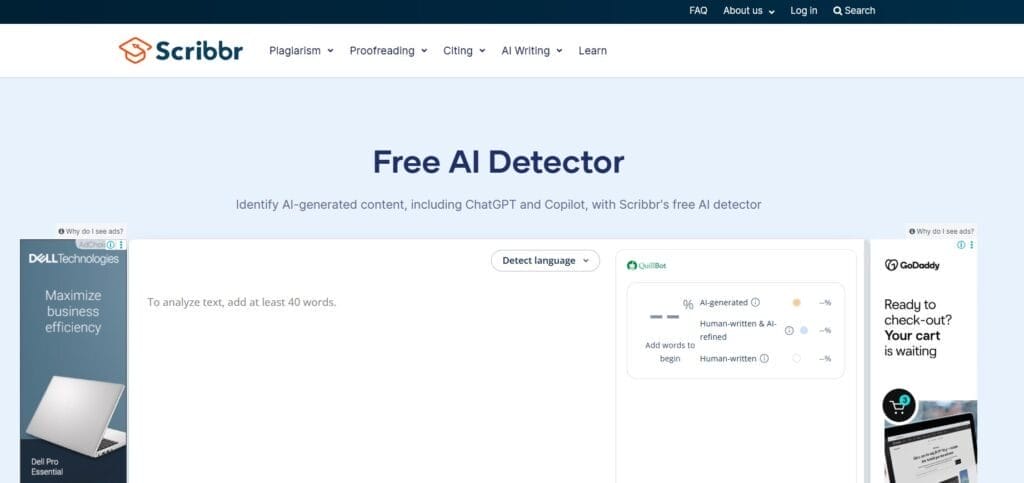
Best for: Students, academic writing and free AI checks
Pricing: Free AI checks available
Good for: Essays, assignments and academic content
Scribbr is popular among students because it focuses heavily on academic writing, plagiarism checking and citation support.
Its AI detector is useful for essays and assignments, but it also clearly notes that no AI detector can provide complete accuracy.
Key Features
- Free AI checks
- No sign-up required
- Paragraph-level feedback
- Academic writing support
- Plagiarism checker ecosystem
- Student-friendly interface
Pros
- Very easy to use
- Good for students
- Free access
- Clear reliability disclaimer
Cons
- Submission limits apply
- Not built for large-scale website audits
- Premium services may be needed for deeper checks
Best Use Case
Use Scribbr if you are a student or teacher who wants a simple AI detector for essays and academic content.
8. Smodin AI Detector

Best for: Multilingual AI detection and student writing tools
Pricing: Free and paid plans available
Good for: AI detection, rewriting, summarising and plagiarism checking
Smodin offers a full AI writing toolkit, including an AI detector, plagiarism checker, rewriting tools and summarisation features.
It is helpful when you want AI detection along with other writing support tools in one place.
Key Features
- AI content detection
- Multi-model support
- Plagiarism checker
- Rewriter
- Summariser
- Multilingual support
Pros
- Useful all-in-one writing toolkit
- Good for students and writers
- Free access available
- Supports different AI models
Cons
- Free usage may be limited
- Interface includes many tools, which can feel crowded
- Detection results still need review
Best Use Case
Use Smodin if you want AI detection along with rewriting, summarising and plagiarism tools in one place.
9. ZeroGPT
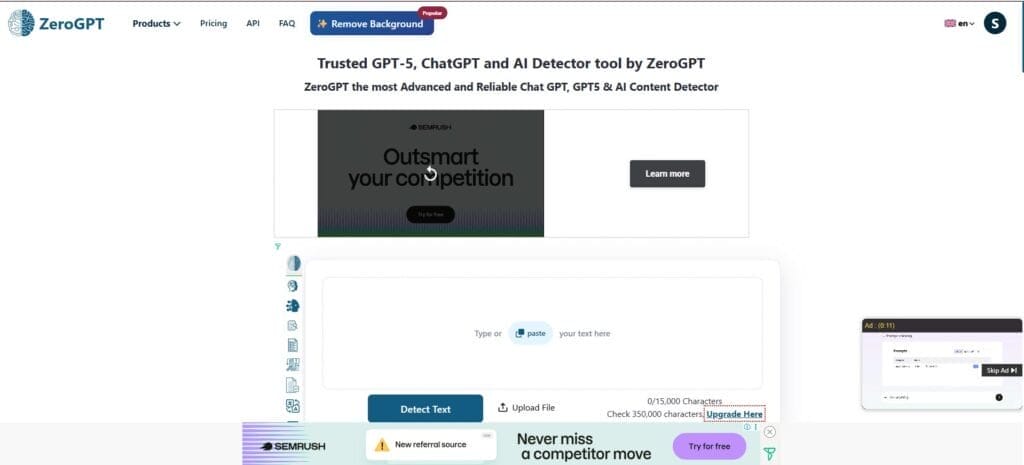
Best for: Free AI detection and simple checks
Pricing: Free and paid plans available
Good for: Quick AI text checks for ChatGPT, Gemini and other models
ZeroGPT is a simple and popular AI detector for quick checks. It is useful if you want to paste text and get a basic result without a complicated setup.
It is best for casual users who want a fast AI content check rather than a full professional audit.
Key Features
- Free AI text detection
- Simple copy-paste interface
- Paid plans available
- API/business options
- Supports multiple AI models
Pros
- Simple and beginner-friendly
- Good for quick checks
- Free access available
- Useful for casual users
Cons
- Not the strongest choice for professional audits
- Accuracy may vary
- Detailed editorial reporting may be limited
Best Use Case
Use ZeroGPT if you need a fast and simple AI detection check without advanced workflow needs.
10. BrandWell AI Detector

Best for: Content marketers and website owners
Pricing: Free AI detector available
Good for: Checking marketing content, blogs and web copy
BrandWell offers a free AI detector for checking whether content appears human-written or AI-generated.
It is useful for marketers, bloggers and website owners who want to check blog posts, landing pages or marketing content for AI-generated patterns.
Key Features
- AI content detection
- Free checking tool
- Plagiarism scanner
- Website/blog AI content checking
- Marketing-focused workflow
Pros
- Useful for content marketers
- Free to try
- Good for blog and website content
- Simple scoring system
Cons
- May not be enough for academic use
- Results should not be treated as final proof
- Some advanced content tools may be part of broader BrandWell products
Best Use Case
Use BrandWell if you are checking blogs, landing pages or marketing content for AI-generated patterns.
AI Detector Comparison Table 2026
| AI Detector | Best For | Free Option | Plagiarism Check | Best Use Case |
| Originality.ai | Publishers and SEO teams | Limited/Paid | Yes | Blog and website content audits |
| GPTZero | Teachers and students | Yes | Limited/Plan-based | Essays and academic writing |
| Copyleaks | Enterprise and education | Yes | Yes | Large-scale multilingual detection |
| Winston AI | Publishers and educators | Trial | Yes | Text, documents and image detection |
| Grammarly | Everyday writers | Yes | Plan-based | Writing and basic AI checks |
| QuillBot | Students and casual users | Yes | Plan-based | Quick free AI checks |
| Scribbr | Academic writing | Yes | Yes, separate | Essays and assignments |
| Smodin | Students and multilingual users | Yes | Yes | AI detection plus writing tools |
| ZeroGPT | Quick checks | Yes | Limited | Simple AI detection |
| BrandWell | Marketers and bloggers | Yes | Yes | Blog and website content checking |
Best Free AI Detector in 2026
If you want a free AI detector, start with:
- QuillBot AI Detector
- Scribbr AI Detector
- ZeroGPT
- GPTZero
- BrandWell AI Detector
- Smodin AI Detector
For students, Scribbr and QuillBot are simple and beginner-friendly options. Teachers can consider GPTZero for academic checks. Bloggers and marketers may use BrandWell or ZeroGPT for quick content reviews. However, for professional publishing, free AI detectors may not provide enough depth or reliability. You may need Originality.ai, Copyleaks or Winston AI for deeper reports.
How to Choose the Best AI Detector?
1. What type of content do you check?
For essays and academic writing, GPTZero or Scribbr are good options. For blog posts and SEO content, Originality.ai or BrandWell work better. If you need to check business documents, reports or professional content, consider Copyleaks or Winston AI. For simple and quick AI checks, QuillBot or ZeroGPT are easy to use.
2. Do you need plagiarism checking too?
If yes, look at Originality.ai, Copyleaks, Winston AI, Scribbr or Smodin.
3. Do you need team access?
For teams, Originality.ai, Copyleaks and Winston AI are better options.
4. Do you need multilingual detection?
Copyleaks and Smodin are stronger options for multilingual workflows.
5. Do you need free usage?
Start with QuillBot, Scribbr, ZeroGPT, BrandWell or GPTZero.
Common Mistakes to Avoid When Using AI Detectors
1. Treating the Score as Final Proof
An AI score is only a signal. Never accuse a student, writer or employee based only on one detector result.
2. Checking Very Short Text
Short text is harder to analyse. AI detectors usually perform better on longer samples.
3. Ignoring Human Editing
AI-assisted content can be edited heavily by humans. A detector may not always understand that difference.
4. Using Only One Tool
For important content, compare results from two or three detectors.
5. Ignoring Content Quality
A text can pass an AI detector and still be poor quality. Focus on usefulness, accuracy and originality.
Limitations of AI Detectors
AI detectors have several limitations:
- They can produce false positives.
- They can miss edited AI content.
- They may struggle with non-native English writing.
- They may not work equally well in every language.
- They may be less reliable for short text.
- They can be confused by paraphrasing tools.
- They cannot always prove intent.
This is why AI detectors should be combined with human review.
For SEO content, the better question is not only “Is this AI-written?” but: is this content useful, accurate, original and helpful for the reader?
Are AI Detectors Worth Using in 2026?
Yes, AI detectors are worth using in 2026, but only if you use them correctly.
They are useful for:
- Teachers checking assignments
- Editors reviewing submissions
- SEO teams checking blog quality
- Agencies managing writers
- Publishers auditing content
- Businesses checking website copy
- Recruiters reviewing suspicious documents
But they are not perfect. They should support human judgement, not replace it.
For a free AI detector, you can start with Scribbr, QuillBot or ZeroGPT. For more advanced and professional content checks, Originality.ai, Copyleaks and Winston AI are better options. If you work in marketing or SEO, BrandWell can also be useful for checking blog posts and website content.
Conclusion
AI detectors are becoming more important in 2026 because AI-generated content is now part of everyday writing, education, publishing and marketing.
The best AI detector depends on your need. Originality.ai is useful for publishers, GPTZero works well for education, Copyleaks is strong for enterprise use, Winston AI is good for reports and document checks, while QuillBot, Scribbr, Smodin, ZeroGPT and BrandWell are useful for quick or free AI detection.
However, no AI detector is perfect.
Use these tools as helpful indicators, then combine the results with human judgement, fact-checking and editorial review.
At Simplify AI Tools, our recommendation is simple: use AI detectors to improve content quality, not to blindly reject content.
FAQs
Originality.ai, GPTZero, Copyleaks and Winston AI are among the strongest AI detector tools in 2026. For free checks, Scribbr, QuillBot and ZeroGPT are good starting points.
Yes, many AI detectors claim to detect ChatGPT content. Tools like GPTZero, Copyleaks, Originality.ai, QuillBot and ZeroGPT support detection for ChatGPT-style content.
Many modern AI detectors now mention support for Claude, Gemini and other large language models. However, detection accuracy can vary depending on the text and editing level.
Free AI detectors can be useful for quick checks, but they may have limits. For important academic, business or publishing decisions, use more than one tool and review the content manually.
Yes. AI detectors can be wrong. They can flag human-written content as AI-generated or fail to identify AI-written content that has been edited or paraphrased.
Yes, but indirectly. AI detectors can help you review content quality and originality. However, SEO ranking depends more on helpfulness, accuracy, user intent, expertise and trust.

Disclaimer: Views are the author’s own. Content is informational only.
Was this article helpful?
A quick vote helps us improve the guides readers find most useful.
Join the discussion
Share your experience, ask a question, or add something useful for other readers.